Outsourced SDR vs In-House Outbound: What's Actually Worth It in 2026

Updated: Aug 4
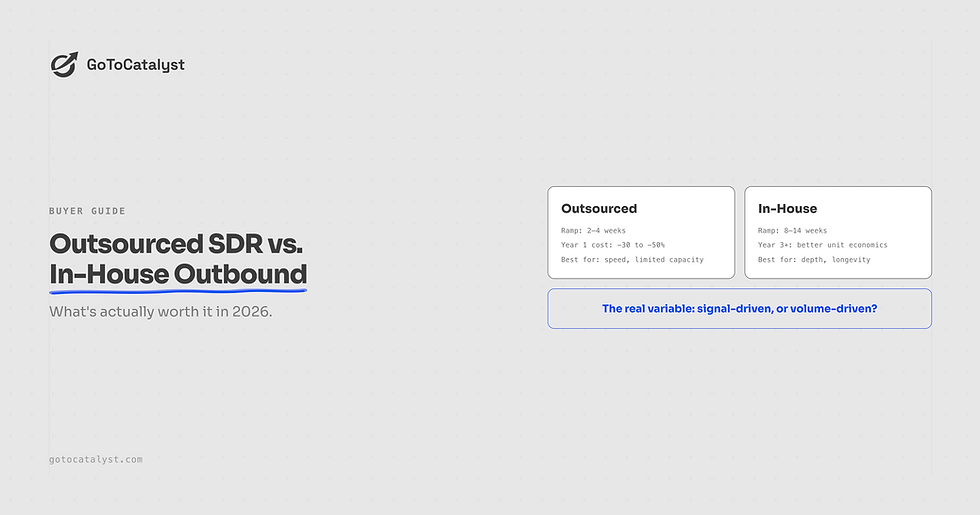
TL;DR: Outsourced SDR agencies win on speed and Year-1 cost (2-4 week ramp vs 8-14 weeks in-house, roughly 30-50% cheaper in year one). In-house wins on long-term unit economics and product depth once reps are past ramp. Neither answers the actual question underneath both: is the outbound motion signal-driven, or just headcount pointed at a list? That's the variable both options usually get wrong.
The real comparison isn't cost. It's what you're actually buying.
Every "outsourced vs in-house SDR" comparison eventually turns into a spreadsheet: agency retainer vs fully-loaded salary. That's a real number, but it's not the number that decides whether either option actually works.
What the numbers say
Outsourced SDR agencies typically run $1,500-$10,000/month depending on scope and team size, with most credible retainers landing in the $3,000-$15,000 range. A qualified in-house SDR costs $125,000-$150,000/year once you load in salary, benefits, tools, and management, against a base salary of $55,000-$65,000. On pure Year-1 math, outsourcing usually wins, often cutting costs 30-50% while improving flexibility.
Speed tells a similar story. Agencies typically deliver first meetings in 2-4 weeks; in-house hires take 8-14 weeks to generate reliable pipeline while a new rep ramps. If the business needs pipeline this quarter, that gap matters more than the invoice.
But the long-term picture flips. In-house tends to win on unit economics by year three, once ramp time and process learning compound, and it's the only path to reps who build real product depth and institutional account knowledge. Agencies win year one on cost, speed, and risk. In-house wins years two and beyond on talent development and depth.
The question neither side answers
Here's what that comparison misses: both an agency and an in-house team can run the exact same failure mode; reps or contractors working a static list, with no signal for who to contact or when, measured on activity instead of account quality.
An agency running spray-and-pray outbound at scale is still spray-and-pray outbound. An in-house SDR working a list with no signal intelligence behind it is still working a list. Insourcing or outsourcing doesn't fix that; it just changes who's doing the guessing.
The actual variable that decides whether outbound works isn't who's pulling the trigger. It's what's informing the trigger; whether outreach is prioritized by real signals (hiring changes, funding events, leadership moves, buying intent) and tiered by account fit, or whether it's volume against a purchased list, whoever's running it.
A third option: signal-driven outbound as infrastructure
This is the gap AI Outbound is built to close, as a third path that isn't just "cheaper agency" or "more control in-house." It's signal-driven account activation: ICP and segmentation architecture, signal intelligence across hiring, funding, and buying-intent data, multi-thread outreach across email and LinkedIn, and CRM integration, connected as one system rather than a headcount decision.
The mechanism matters more than who's on the other end of the sequence. A rep (agency or in-house) working from real signal data will consistently outperform a rep working a static list, regardless of which column they show up in on your P&L.
How to actually decide
If the real question is agency vs in-house, here's a more useful way to frame it:
Need pipeline this quarter, with limited internal capacity? An agency's 2-4 week ramp wins on speed. Ask specifically what signal data informs their targeting, not just headcount and call volume.
Building for 2+ years, with product complexity that rewards deep account knowledge? In-house wins long-term, but only if reps are working from real account intelligence, not just a bigger list.
Either way, is targeting signal-driven or volume-driven? This is the variable that actually predicts results, and it's independent of the agency/in-house decision entirely.
The bottom line
Outsourced SDR agencies and in-house outbound teams are answering a resourcing question. The question that actually determines whether outbound produces pipeline is a targeting question: is the system built around real signal, or is it running on volume with a headcount label attached?
Get that part right, and the agency-vs-in-house decision becomes what it should have been all along: a question of speed, budget, and internal capacity, not a referendum on whether outbound works at all.
FAQ
Is outsourced SDR cheaper than in-house?
In year one, usually yes, often 30-50% cheaper with faster ramp. By year three, in-house typically wins on unit economics once ramp time and process learning compound.
How long does it take to see results from each?
Agencies typically deliver first meetings in 2-4 weeks. In-house hires take 8-14 weeks to generate reliable pipeline while ramping.
Can you combine outsourced and in-house outbound?
Yes, and many companies do; using an agency for initial speed while building an in-house team for long-term depth. The mechanism (signal-driven targeting) matters more than which model delivers it.
What should actually decide the choice?
Timeline and internal capacity should decide agency vs in-house. Whether targeting is signal-driven or volume-driven should decide whether outbound works at all, independent of that choice.

